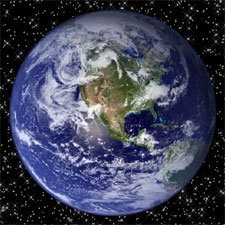
It is with earnest consciousness about the state of our environment, and thus, our planet, and the human species and all other species on this planet, that I honor the following words by Bill McKibben of the Los Angeles Times article published on May 11, 2008, entitled, Civilizations Last Chance. The words he wrote follow. Please consider them with utmost solemnity.
And I ask you to consider this recent scientific finding that can possibly change our fate and our world: single-cell algae readily consume carbon dioxide and other power plant emissions and emit oxygen during photosynthesis.
---------------------------------------------------
Civilization's Last Chance
The planet is nearing a tipping point on climate change, and it gets much worse, fast.
By Bill McKibben
May 11, 2008 Los Angeles Times
Even for Americans -- who are constitutionally convinced that there will always be a second act, and a third, and a do-over after that, and, if necessary, a little public repentance and forgiveness and a Brand New Start -- even for us, the world looks a little terminal right now.
It's not just the economy: We've gone through swoons before. It's that gas at $4 a gallon means we're running out, at least of the cheap stuff that built our sprawling society. It's that when we try to turn corn into gas, it helps send the price of a loaf of bread shooting upward and helps ignite food riots on three continents. It's that everything is so tied together. It's that, all of a sudden, those grim Club of Rome types who, way back in the 1970s, went on and on about the "limits to growth" suddenly seem ... how best to put it, right.
* DUST-UP:
The new scarcity
* BLOWBACK:
Where are the salmon?
All of a sudden it isn't morning in America, it's dusk on planet Earth.
There's a number -- a new number -- that makes this point most powerfully. It may now be the most important number on Earth: 350. As in parts per million of carbon dioxide in the atmosphere.
A few weeks ago, NASA's chief climatologist, James Hansen, submitted a paper to Science magazine with several coauthors. The abstract attached to it argued -- and I have never read stronger language in a scientific paper -- that "if humanity wishes to preserve a planet similar to that on which civilization developed and to which life on Earth is adapted, paleoclimate evidence and ongoing climate change suggest that CO2 will need to be reduced from its current 385 ppm to at most 350 ppm."
Hansen cites six irreversible tipping points -- massive sea level rise and huge changes in rainfall patterns, among them -- that we'll pass if we don't get back down to 350 soon; and the first of them, judging by last summer's insane melt of Arctic ice, may already be behind us.
So it's a tough diagnosis. It's like the doctor telling you that your cholesterol is way too high and, if you don't bring it down right away, you're going to have a stroke. So you take the pill, you swear off the cheese, and, if you're lucky, you get back into the safety zone before the coronary. It's like watching the tachometer edge into the red zone and knowing that you need to take your foot off the gas before you hear that clunk up front.
In this case, though, it's worse than that because we're not taking the pill and we are stomping on the gas -- hard. Instead of slowing down, we're pouring on the coal, quite literally. Two weeks ago came the news that atmospheric carbon dioxide had jumped 2.4 parts per million last year -- two decades ago, it was going up barely half that fast.
And suddenly the news arrives that the amount of methane, another potent greenhouse gas accumulating in the atmosphere, has unexpectedly begun to soar as well. It appears that we've managed to warm the far north enough to start melting huge patches of permafrost, and massive quantities of methane trapped beneath it have begun to bubble forth.
And don't forget: China is building more power plants; India is pioneering the $2,500 car; and Americans are buying TVs the size of windshields, which suck juice ever faster.
Here's the thing. Hansen didn't just say that if we didn't act, there was trouble coming. He didn't just say that if we didn't yet know what was best for us, we'd certainly be better off below 350 ppm of carbon dioxide in the atmosphere.
His phrase was: "if we wish to preserve a planet similar to that on which civilization developed." A planet with billions of people living near those oh-so-floodable coastlines. A planet with ever-more vulnerable forests. (A beetle, encouraged by warmer temperatures, has already managed to kill 10 times more trees than in any previous infestation across the northern reaches of Canada this year. This means far more carbon heading for the atmosphere and apparently dooms Canada's efforts to comply with the Kyoto protocol, which was already in doubt because of its decision to start producing oil for the U.S. from Alberta's tar sands.)
We're the ones who kicked the warming off; now the planet is starting to take over the job. Melt all that Arctic ice, for instance, and suddenly the nice white shield that reflected 80% of incoming solar radiation back into space has turned to blue water that absorbs 80% of the sun's heat. Such feedbacks are beyond history, though not in the sense that Francis Fukuyama had in mind.
And we have, at best, a few years to short-circuit them -- to reverse course. Here's the Indian scientist and economist Rajendra Pachauri, who accepted the Nobel Prize on behalf of the Intergovernmental Panel on Climate Change last year (and, by the way, got his job when the Bush administration, at the behest of Exxon Mobil, forced out his predecessor): "If there's no action before 2012, that's too late. What we do in the next two to three years will determine our future. This is the defining moment."
In the next two or three years, the nations of the world are supposed to be negotiating a successor treaty to the Kyoto accord (which, for the record, has never been approved by the United States -- the only industrial nation that has failed to do so). When December 2009 rolls around, heads of state are supposed to converge on Copenhagen to sign a treaty -- a treaty that would go into effect at the last plausible moment to heed the most basic and crucial of limits on atmospheric CO2.
If we did everything right, Hansen says, we could see carbon emissions start to fall fairly rapidly and the oceans begin to pull some of that CO2 out of the atmosphere. Before the century was out, we might even be on track back to 350. We might stop just short of some of those tipping points, like the Road Runner screeching to a halt at the very edge of the cliff.
More likely, though, we're the coyote -- because "doing everything right" means that political systems around the world would have to take enormous and painful steps right away. It means no more new coal-fired power plants anywhere, and plans to quickly close the ones already in operation. (Coal-fired power plants operating the way they're supposed to are, in global warming terms, as dangerous as nuclear plants melting down.) It means making car factories turn out efficient hybrids next year, just the way U.S. automakers made them turn out tanks in six months at the start of World War II. It means making trains an absolute priority and planes a taboo.
It means making every decision wisely because we have so little time and so little money, at least relative to the task at hand. And hardest of all, it means the rich countries of the world sharing resources and technology freely with the poorest ones so that they can develop dignified lives without burning their cheap coal.
It's possible. The United States launched a Marshall Plan once, and could do it again, this time in relation to carbon. But at a time when the president has, once more, urged drilling in the Arctic National Wildlife Refuge, it seems unlikely. At a time when the alluring phrase "gas tax holiday" -- which would actually encourage more driving and more energy consumption -- has danced into our vocabulary, it's hard to see. And if it's hard to imagine sacrifice here, imagine China, where people produce a quarter as much carbon apiece as Americans do.
Still, as long as it's not impossible, we've got a duty to try to push those post-Kyoto negotiations in the direction of reality. In fact, it's about the most obvious duty humans have ever faced.
After all, those talks are our last chance; you just can't do this one lightbulb at a time.
We do have one thing going for us -- the Web -- which at least allows you to imagine something like a grass-roots global effort. If the Internet was built for anything, it was built for sharing this number, for making people understand that "350" stands for a kind of safety, a kind of possibility, a kind of future.
Hansen's words were well-chosen: "a planet similar to that on which civilization developed." People will doubtless survive on a non-350 planet, but those who do will be so preoccupied, coping with the endless unintended consequences of an overheated planet, that civilization may not.
Civilization is what grows up in the margins of leisure and security provided by a workable relationship with the natural world. That margin won't exist, at least not for long, as long as we remain on the wrong side of 350. That's the limit we face.
Bill McKibben, a scholar in residence at Middlebury College and the author, most recently, of "The Bill McKibben Reader," is the co-founder of Project 350 ( www.350.org), devoted to reducing carbon dioxide in the atmosphere to 350 parts per million. A longer version of this article appears at Tomdispatch.com.
Friday, May 16, 2008
Civilization's Last Chance

Thursday, March 22, 2007
Earthkeeper Rite
Dear friends and stewards of Earth,
I just saw Al Gore speaking before a Senate Committee asking them to please do something to protect the environment. After seeing An Inconvenient Truth twice, and experiencing profound respect for this Academy Award Winner for Best Documentary 2006, I felt intrigued by what he had to say to the Senate.
As I listened to his eloquent and sincere speech I was proud of him and relieved he was doing it.
But I was absolutely sickened and shocked when the response from U.S. SENATORS to him was "there are meteorologists, scientists, physicists, biologists, oceanographers, and experts around the world who all disagree with you".
This upset me so much, to think that our government representatives are so ignorant or driven by corporate interests (albeit investing in alternative energy is financially advised for its viability and profitability) as to not see the value and import of acting now to protect the environment.
How can they not act to make changes in our laws to help cut back on green house gas emissions and clean up and protect our environment??!?!?!!!
It's absolutely immoral.
This brings me to the whole idea of ethics/morality and the environment.
When I was 20 I achieved honor status from 3 semesters of undergraduate studies at various California Community Colleges (considered to be as good as or better than most state colleges around the country).
Having lived in California for years, I was absolutely in love with the majestic redwood forests, the pristine and dramatic coast lines and marine life, and the clean fresh air of Mendocino, Marin, and Sonoma counties. When I’d drive across the Golden Gate Bridge from a day of hiking around Mount Tamalpais in Marin County, I’d look across to the East Bay and see a thin layer of dingy sky. Is that fog, I asked myself, squinting to see it better, gulping as I noticed it was brown, not fog-like grey.
It was then and there, at age 18 that I realized human beings are polluting our environment through the way they live. It was right then that I felt I had to do something to help change this!
Influenced by the gorgeous natural environments in the North Bay, and the shock of seeing the browning sky over the East Bay, I studied philosophy, marine biology, dance, and comparative mythology and religion.
At first, when told I had to declare a major, I chose Marine Biology, and took many oceanography courses (being in coastal California made it easy to take a variety of classes on this topic).
My thoughts were that, in 1988, the signs of our planetary pollution were already clear to me. I saw ahead and envisioned a day when we could not breathe the air or drink our water without being poisoned or toxified.
I felt the answer would be in saving the ocean, and I felt it was a moral imperative to act to take care of the environment.
As a result, I took many philosophy classes and read and thought a lot about morality. I also headed up the first Earth Day committee in a California Community College System and arranged a huge Earth Day celebration that helped Orange County, CA get a recycling program.
That year, I was poised to graduate with an AA degree and had to decide where I wanted to apply for the next level of my education.
I applied to UC Berkeley, because I love the Bay Area and heard a lot about the university's Philosophy and Environmental studies programs. I felt absolutely focused and positive that I'd help impact thoughts on pollution and the environment through these studies.
So, I wrote my required 10 page application essay, the thesis of which was Environmental Protection as Moral Imperative, and linked the cause of protecting the environment to the human species survivability, and our obligation to protect our habitat.
I immediately got accepted and granted a scholarship for my first semester at UC Berkeley (locally called "Cal"), in 1990.
What happened to my goals then never changed. I've always felt passionate and concerned about environmentalism, conservation of species and natural habitats, and worried about global pollution and climate change. (I've been a member of the World Wildlife Fund, Sierra Club, and Natural Resources Defense Council since the late 1980's).
I've felt the dire need for Americans to change their lifestyles to protect their habitats.
I got involved in the first environmental club at UC Berkeley and hosted a 1992 Earth Day Festival on campus that spring, inciting many to pledge to recycle and conserve energy in their homes.
Throughout the early 90’s I involved myself with activities that represented my concern for our environment. I started a “Green” cleaning service and procured many clients in the Bay Area who were happy that I vowed to clean their houses with non-toxic substances (lemon, vinegar, baking soda, Simple-Green), and to recycle their household goods (where neighborhood recycling programs were not yet implemented).
I did this for many years, and supported myself financially through this green housecleaning and grants from school.
I also worked for the Sierra Club, Green Peace, and Clean Water Action to raise public awareness of environmental issues. I helped to raise money to protect habitats and species, implement initiatives, and educate the public. Through my campaign I helped to register thousands of new memberships in these environmental organizations and many others.
In the late 90’s, I stumbled on some hard times and unfortunate circumstances in my life, and my path to be an environmental activist became a bit obscured, but now I am back!
For several years I wanted to start a local, community based and run, renewable power company. I thought that people could band together and purchase and develop a solar powered power plant (a huge photo-voltaic array) that would provide power for the community. I believed that people would do this and that it could be done and that it was revolutionary in our use of energy.
I tried to gather supporters of this idea when I lived in Occidental (a very green and progressive community in Sonoma County, CA), but there were so many nay-sayers and doubters that it fell apart very quickly.
In essence, I simply lacked the capital to buy and set up the photovoltaic array and start the solar power company myself.
I had tons of data from the Real Goods Solar Institute in Hopland, CA about how easy it is to set up an array and provide solar power as an alternative to fossil fuel burning or nuclear generated energy. I was convinced that local people in my community would see the logic of setting this up and switching to be “off the grid and independently supported”.
Alas, financial greed reigned supreme over our own health and well-being.
When I moved to Oregon, for a short time in 2005, I got a job as a web-developer and campaigner for Green Mountain Energy, a renewable power company that has succeeded in providing wind, solar, and geo-thermal power to Oregon residents through the Oregon power company, PGE (not to be mistaken with the illustrious California PG&E, who recently invested a ton in the solar powering of the SF Giants ball park!).
I found out, through my work for Green Mountain, that the state of Oregon (government officials) legislated that PGE or any power company in the state had to provide at least 30% of the power provided to customers from renewable resources.
This was absolutely amazing to me! I was so happy to learn this! I was convinced this was just the beginning of a wave of environmental legislation that would sweep the country and change our lifestyles for the GOOD of all.
Alas, that was 3 years ago and no other states have followed suit. But they can!
We need to influence our representatives to do so!
We can make local power companies and do it ourselves! Get together with your friends and neighbors and raise the money to put in a photo-voltaic array and hook up your energy supply to it! Get off the grid! Stop using poisonous gasses for your light switch, your TV, your computer, your dishwasher, your garage door opener, your refrigerator, your hot water heater, your lifestyle!
I know this sounds pollyanna and hopeful, but it’s reality, it’s doable, it’s real, and it’s vitally important to start thinking this way.
Research and look into ways that you can conserve energy and change your life to help protect our environment.
I prefer to say “our” environment, rather than “the” environment, because it makes it more personal, more intimate, and more accurate. It’s not some dry, obscure, impersonal “the”. No, it’s OURS, our home, our world, our habitat, our life-support system! We need to claim environmental concerns as the most dire and deep ethical matter to act upon and take seriously RIGHT NOW.
When I lived in Bloomington, Indiana, from October 14th, 2005 to February 28th, 2007, I had the opportunity to meet Barbara Ann O’Leary, who introduced me to the Incan Munay Ki Rites, a series of initiations for personal psycho-spiritual growth.
When I first read the pamphlet that Barbara put together about the rites, my eyes scanned down the list and nearly popped out of my head when I saw the words, “Earthkeeper Rites”. I knew then and there that I had to get these rites. That having the Earthkeeper Rite felt inspiring and empowering, as though by taking this rite, I was claiming my commitment, once and for all, to act to protect our planet, Earth, our home, our habitat, our life-support. I’m very thankful to Barbara and the Incans for allowing me to become part of this lineage.
Now, having heard Al Gore speak before the Senate today, and having seen the disgusting, reprehensible, immoral response to him by members of the U.S. Senate, I feel mandated by my commitment to help protect our environment by writing every single congressperson (House Representatives and Senators) to ask them to act on legislation to protect our environment.
So far, I’ve written and sent 12 letters. And now, I ask that you please do the same.
Each of us has an obligation to protect our home, to preserve our survivability, to act and live in accordance with moral principles that will allow us and future generations and other species to thrive and survive.
So, please, take some time to find your own relationship and commitment to protecting our environment, and visit the Congressional list of emails and contact information and send an urgent request to research and act on protecting our environment NOW.
--The list of contact information for U.S. Senators.
--The list of contact information for the U.S. House of Representatives
Here is a sample letter that you can send or message you can leave for them:
Hello,--
I am writing to all the Congresspersons in our country (the United States of America) to beg you to please research and act upon legislation and initiatives that will help reduce green house gas emissions and mandate the use of renewable resources for energy.
I want you to act to stop global climate change that will threaten the survivability of the human species on planet Earth.
I beg you to consult your conscience about the moral obligation you have as a congressperson to influence legislation to protect the environment.
Thank you,
Leila Kincaid
USA Citizen and Voter
THANK YOU for taking the time to read and seriously consider this post.
Obliged,
Leila Kincaid
Writer, Earthkeeper, Visionary
425.749.8996
leilakincaid@gmail.com
When asked: "How has being a goodwill ambassador for UNHCR changed your life? "
Angelina Jolie replied "It has given me a life filled with purpose. Who are we if we are not useful to others?"
May her hard work and dedication to helping the impoverished in our world be an inspiration to you to find how you are useful to others and live that.




 Posts
Posts